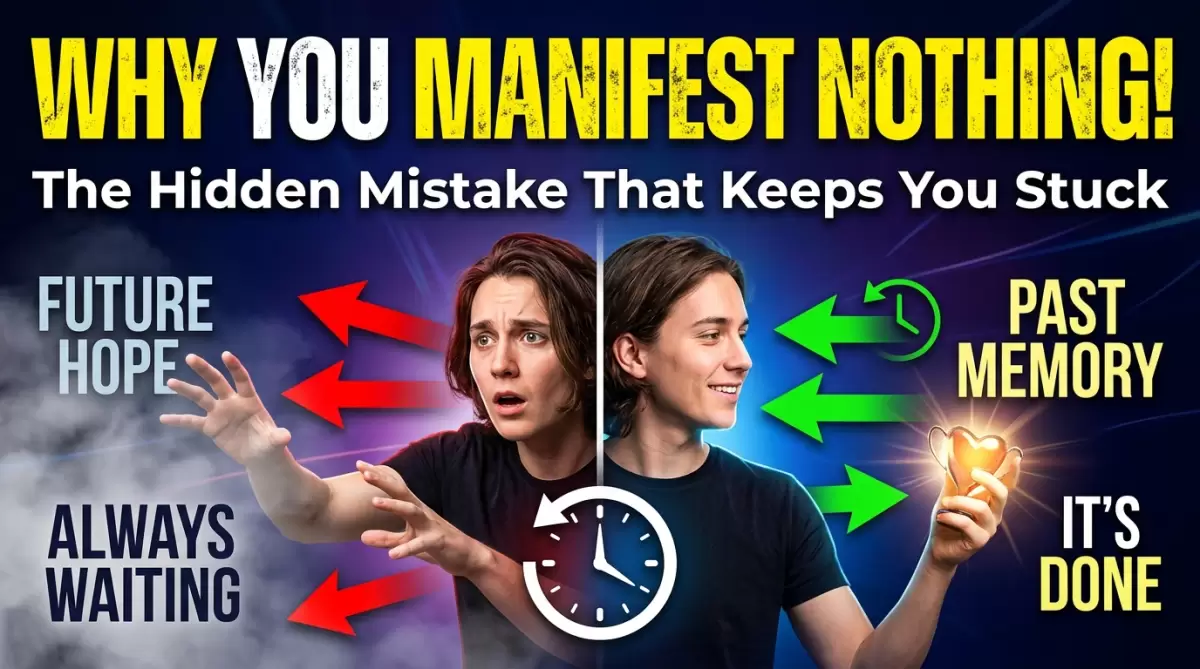
The transcript teaches a simple but powerful idea: stop treating your desire like something that is still coming, and start feeling it like something that has already happened. The whole method is built around one mental shift. Instead of thinking, “I hope this happens,” you begin thinking, “I remember when this happened.”
This matters because most people place their goals in the future. They keep waiting, hoping, and visualizing from a state of lack. That keeps the desire mentally far away. The transcript argues that the future is not where anything is received. Everything is experienced in the present moment, so the inner state you hold now matters more than the outcome you chase later.
The main technique is to create a “memory of the future.” In simple terms, you mentally jump ahead to a time when your desire is already fulfilled, and then look back on it as if it already happened. If you want money, you do not imagine the money arriving. You imagine that months have passed and financial stability is now normal. If you want love, you do not imagine meeting someone. You imagine being well into the relationship, where it already feels settled and real.
This shift changes the emotional tone. Hope creates tension. Memory creates calm certainty. The transcript repeatedly emphasizes that the feeling should be ordinary, settled, and unforced. That ordinary feeling is what makes the practice powerful.
The transcript explains that the subconscious mind does not process time the same way the conscious mind does. It does not care whether a memory is from yesterday or created in imagination. It responds to the feeling of fact. So when you repeatedly imagine your desire as already complete, your mind begins accepting it as real. From there, your thoughts, behavior, and attention naturally start aligning with that assumption.
The article also makes one important point: the method is not about forcing belief or obsessing over the result. It is about removing the question “how will it happen?” If you already remember it as done, the how becomes irrelevant. That detachment is part of the technique.
The transcript gives a simple routine:
In the morning, before getting out of bed, spend a short time imagining that your desired life is already normal. Then look back and remember how it happened.
During the day, notice when your mind slips into waiting mode. Every time you catch yourself thinking “when will it happen,” shift to “I remember when it happened.”
At night, do the full practice before sleep. Go beyond the moment of receiving and place yourself into the after. Then create vivid memories of the day it all came together, the call you made, the relief you felt, and the moment you knew it was real. Sleep from that state of completion, not from desire.
The transcript’s message is direct: stop living in the state of not yet. Instead, mentally occupy the state of already done. According to the lecture, that is how you train consciousness to match the reality you want. Whether you view it as a spiritual practice, a mindset tool, or an imagination exercise, the principle is the same. What you consistently feel as true becomes the state your mind returns to again and again.
StoryKafe is a dynamic online hub for storytelling, empowering creators to share meaningful, user-generated content across topics like business, technology, health, education, and beyond - turning stories into impactful conversations.